02

Let us now talk about two points: the relationship of the author with his venerated friend James Joyce and his experience in the war, two decisive events for his later artistic work period, and consequentley, for «Waiting for Godot».

The shared times and experiences of the author with the well-known writer James Joyce signified an important period for Beckett that «marked out his own zone of artistic exploration» (Pattie 29). They were good and close friends during many time and both had a great interest in literature and art in general, but in this case, Joyce was the older, and Beckett the young that admired him so much. What is more, this veneration influenced him about the idea of being a writer. However, Beckett soon realized he could not imitate him: their visions of the world were too different. The disappointed artist saw that his friend’s style was epic, heroic: he always wanted to get far and far, to discover and to enrich himself of knowledge: «The more Joyce knew, the more he could», confessed the same Beckett, who used to remember him talking with illusion, emotion, and enthusiasm, just the opposite that happened with him. He knew his destiny was not one of a hero, of a winner. As we said at the beginning of the essay, he always «had little talented for happiness», and he saw himself more as a ‘non-knower’, a ‘non-can-er’ (Knowlson 352-353). At this precise moment, Beckett lost an ideal, but won a search of his true although dark identity, or at least, his style: essential for his later artistic creations.

I realized that Joyce had gone as far as one could in the direction of knowing more, in control of one’s material. He was always adding to it; you only have to look at his proofs to see that. I realised that my own was impoverishment, in lack of knowledge and in taking away, substracting rather than adding. When I first met Joyce, I didn’t intend to be a writer. That only came later when I found out that I was no good at all at teaching. When I found I simple couldn’t teach. But I do remember speaking about Joyce’s heroic achievement. I had a great admiration for him. That’s what it was: epic, heroic, what he achieved. I realized that I couldn’t go down that same road. (Knowlson 352-353)

Several critics have related this relationship with the one of the fictional characters Pozzo and Lucky in Godot: «Pozzo and Lucky […] are […] Body and Intellect, Master and Slave, Capitalist and Proletarian, Colonizer and Colonized […], even Joyce and Beckett» (Mooney 46). Pozzo in the play is the man of society that knows and act; that talks with a lyrical style and knows what happens at the present time. He aspires to be the protagonist, to be heard and to create entertainment for his audience Vladimir and Estragon. Lucky, instead, is a passive creature: he does not know, he does not move.

Between 1939 and 1946 passed the terrible Second World War and the Nazi’s invasion, against which Samuel Beckett fought intensely from Paris helping in commitments. The massive migrations of people, the famines and the endless deaths as wells as the uncertainty of how much it would long caused a big impact on the author. Such horrors and cruelties disappointed him even more in relation to his attitude towards life: after war he would not believe in rationality and progress anymore, it was absurd to have «hope in a hopeless world» (Mooney 46). Thus he decided that «after a rational attempt to order the outside world, his fiction should deal with the ‘darkness’ of the inner self.» (Pattie 29). From this moment, the post-war traumatic experience signified for the author a long time of intense grief and mental illness (which he had been carrying: panic attacks, neurosis…) that paradoxically would be very fruitful between 1945 and 1953. Effectively, this is the most productive and innovative period of the artist, and gets to captive a huge audience perplexing them. In the following stages, poverty, desolation, bewilderment and disorientation will predominate, likely to what happens in Godot.

–The best thing would be to kill me, like the other.

-What other? […]

-Like billions of other. (Beckett 62)

«Waiting for Godot; A Tragicomedy in Two Acts» belongs to this innovative phase, written in 1949. In it is perfectly illustrated this artistic exploration, in which is present this simplicity and impoverishment of style so opposited to the other one of Joyce and this irrationality and despair intensified by the damage of war.

First of all, the element of the simplicity is essentially reflected in the fact that he first wrote the play in French («En Attendant Godot») and not in English, his native language, because in this way he «[…] gained a greater simplicity and objectivity [concentrating] on a more direct expression of the search for ‘being’ and on an exploration of ignorence, impotence and indigence. [And he also could] concentrate more on the music of the language, its sounds and rhythms […]» (Pattie 74)

Abandoning the notions of rationality and logic of the so well constructed modern plays, Beckett with this play disrupted the dramatic conventions creating a «central tension between structure and content» (Pattie 64). The structure of the play, that is, two acts whose second act is almost a repetition of the first, moreover, the slight but no less important differences are left unexplained intentionally; the desolated stage with no more than a tree and the few characters, is more defined and organised than the content in the sense that it only «tends toward disintegration, toward shapelessness» (Pattie 64). Actually, the action of the play is the ‘no-action’: the characters Vladimir and Estragon spent the time in a place similar to the ‘nothingness’, doing an activity which is not activity, that is, waiting.

-Let’s go

-We can’t

-Why not?

-We’re waiting fot Godot!

This is groundbreaking because the author have not built a piece of theatre with a determined action developed instanteously trough the acting of the characters: in Godot, the characters themselves know that for make the time pass faster they will have to fill this period of time with action. And this panic of the ‘nothingness’ and ‘emptiness’ trying to be avoided with intentions of action that never arrive, just are said, is what constituted the action of the play.

Neither the conventional concept of what is a characters is present in Godot. A character always had represented a fictional individual that for some hours is real and close to the audience because as the time pass, the audience relate them with what the author have wanted to construct: the character has a personal story, a biography, past experiences and memories, which are not directly represented in the play, but just as an idea. However, the audience does not know nothing about Vladimir, Estragon, Pozzo, Lucky, and the messenger boy. We can’t make us an idea of their identity, what they represent individually, and this is due to that they merely have a function: to express ‘the zone of being’ of all human in general. They represent the pain of the existence (the human condition), in which the audience and reader felt identified.

For further comprehension (or just for curiosity) of what I already have explained, you can see this video «Not I», a twenty-minute dramatic monologue also by Samuel Beckett, in which he reduces the concept of character in a mouth that talks. No story, no history, no past, no body: just a mouth that is a merely a mean for express the author’s ideas, the story he has created.

Publicado en Sin categoría | Deja un comentario

01

When we think of Samuel Beckett, we conceive him as one of the most peculiar and eccentric writers of the twentieth century, that man who wrote »such strange plays and novels». And Samuel Beckett, as the rest of the artists, has merely reflected in his work his own personality, that has been forged by several events through his life. When one discovers «Waiting for Godot», and after having overcome that cloud of perplexity and bewilderment so familiar in Beckett’s plays, might think his life had to be extremely unusual and unstable, but the fact is that it is more complex than what it seems.

On the one hand, his childhood in Dublin was not precisely conflicting. He was born in a wealthy family, which allowed him to «enjoy» of a great number of commodities: school education, private piano classes, several kinds of sports… Moreover, the family (his mother, his father and his eldest brother) was quite united. Thus, we could say, Beckett on his early age lead a normal and quiet life which doesn’t coincide with his later artistic ideas. However, behind all these superficial facts are hidden those dark and bleak elements as well as those more instinctive and irrational that so much characterizes his writings. The artist confessed in his adult life that although it seems he had a happy childhood, he actually «had little talent for happiness». Despite his daily activities and his parents’ attention, he felt lonely and away from the real or physical world most of the time. This self-contained and shy young artist was more talented for being in his own, without having to depend on anyone, rather than for a happy and sociable life. In Godot this obscurity is present as an essential characteristic. The early unhappiness of a young Beckett is captured in the tragic experience of Vladimir and Estragon, two men ‘being-in-the-world’ (a Heideggerian term) whose emptiness brings them inevitably to wait for something or to the wishful thinking that there is something to wait for (Godot):

-I’m unhappy

-Not really! Since when?

-I’d forgotten (Beckett 50)

Thus the ‘act’ of waiting becomes into a false illusion of acting that helps them to believe they are someone, that they are alive having a role in the world: «We always find something, eh Didi, to give us the impression that we exist?” (69). They need to find external entertainment to make the time pass faster, so this sour experience of ‘being-in-the-world’ can be more bearable.

-That passed the time

-It would have passed in any case

-Yes, but not so rapidly (Beckett 48)

However, this response of trying to mantain the minds occupied actually does not solve the problem of the emptiness and anguishness. Despite of all the social activities and material things Beckett could acquire being a child, his concerns went beyond and all these entertainments did not impede him abandon the loneliness. The act of waiting in the play as well as the early life of its author became into physical and verbal routines, the difference is that Vladimir and Estragon do it in an attempt to reject that boredom and silenced pain, and for Beckett the routine and habit itself is the reason of his emptiness: «The air is full of cries. But habit is a great deadener»(Beckett 91). For this reason, in his adult life he made every effort to avoid it. This bleak and nihilist thought is well reflected in one of the final dialogues by the character Pozzo: «They give birth astride of a grave, the light gleams an instant, then it’s night once more» (Beckett 89). Man is born to live, to stay in the world: that is his only sense, his only purpose, and then, die.

But this tragic vision of the world was only the calmer and more untroubled side of Samuel Beckett, as his desire for experimentation also surfaced being a child. This curious boy used to try dangerous things: provoking explotions, jumping from trees…(Pattie 6). He simply felt pleasure in observing the result, the consequences of such an irrational decision taken without too much hesitations. Such real scene of the early life of the author could be connected with the artistic one created by himself in Godot in which Vladimir innocently suggests to his friend Estragon that they could try to hang themselves on the tree, just for the mere pleasure of seeing his mad idea come true or for experiment an erection:

-What do we do now?

-Wait

-Yes, but while waiting

-What abot hanging ourselves?

-Hmm. It’d give us an erection! (Beckett 17)

The relationship of Samuel Beckett with his relatives and close friends was also very influential for the representation of the characters in Godot.

As we said before, Beckett since being a child always tried to escape from the routine of Dublin, finding in Paris peace and independency, and even more when the burden of the everyday life, of the habit, was intensified due to hismothercontinuous control. As Pattie stated, «Beckett’s relationship with his mother was not so simple» (7). May Beckett was a very strict, always obssessed for the order and good manners, «a forbidding woman with a tendency toward depression» (Pattie 7), apart from her several attacks of neurosis. It could explain the later Beckett’s «troubled development as a man and as a writer» (Pattie 8), although behind all this lied a strange and irrational love between mother and son. There was real love between them, despite both were stubborn and proud: it was their strong personality and temper which provoked several arguments. This relationship of hate-love, understanding and not understanding, unstable but passionate in some sense, could be reflected in the relationship of Vladimir and Estragon, Gogo and Didi, as they call each other more affectionately. They need to remain physically separated in occasions, as there is a kind of repulsion and voluntary distancement, but after a short time, they need each other again («embrace me!»): «[…] I wonder if we wouldn’t have been better off alone, each one for himself. We weren’t made for the same road.» (Beckett 53) The incompatibility hides a background of dependency: «Don’t touch me! Don’t question me! Don’t speak to me! Stay with me!» (Beckett 58) .

Retaled to this point of the complex incompatibility, we find that it is because Didi is not so different from Gogo, as Beckett was not from his mother (as I pointed out before, they had a similar strong temperament). In fact, one is the reflect of the other, and for this reason they needed to be kept away, because when observing each other they could not stand that sensation of terror seeing oneself reflected in the other. And each one (Vladimir and Estragon) represents the pure loneliness, the anguishness and the dark freedom as part of the existence. They are aware of their painful and boring destiny, and consequently, as Ronan Mc Donald states, they «invent or idealize a delusory system of purpose of belief»(53) (that is, wait for Godot, look for entertainment). But their «destiny» is as uncertain as the arrival of Mr. Godot.

When Vladimir refuse to listen to the dreams of his «friend» Estragon, that is, to join his deepest privacies, is because he is afraid of finding himself.:

-I had a dream

-Don’t tell me!

-I dreamt that-

-DON’T TELL ME!

-[…] Who am I to tell my private nightmares to if I can’t tell them to you?

-Let them remain private. You know I can’t bear that. […] (Beckett, 16)

Just in this sense, can be made a comparison of this ficticious relationship with the other one of Samuel Beckett and May Beckett, since it we can’t forgotten that Vladimir and Estragon are two characters who represent many more things: a human universal concern. They do not form a real couple as Beckett and his mother; they are a pseudo-couple, «a couple who periodically think and act as one» (Pattie 74) and that at the same time as Kaelin argues «they symbolize the schizoid unity of the human unity» (48). They can’t stand the suffering of the solitude, so they need to create this pseudo-unity.

On the other hand, analyzing this more deeply, we find that this psychological unity they form is actually (and curiously) made or mixed of two distinct natures or characters. The two tramps are distinguishable for their opposite comic indentities, and this is quite reflected in their dialogues and actions. As David Pattie describes, «they engage in long dialogue exchanges that would not be out of place in a music-hall» (75)

-They make a noise like wings

-Like leaves

-Like sand

-Like leaves

-They all speak together

[…]

-They rustle

-They murmur

-They rustle (Beckett 62)

The poetic and sometimes banal meaning of their words can’t be identified specifically with Vladimir or Estragon: the dialogues are interchangeables. They are simple, brief, funny and carry a marked rythm. However, it is not the same case with theit actions or «verbal routines» (Mooney 44): What smells (or «stinks») inVladimir is the breath, in Estragon, the foot; Vladimir is obssessed with his hat, Estragon with his shoe. But the famous and basic oppositions which characterize «Waiting for Godot» through all the play, is Vladimir as the father, the mature, the intellectual who takes care of his »son» Estragon, the childish, the simple, the instinctive. «That’s the idea, let’s contradict each other» (Beckett 64). A combination of activity and passivity functions simultaneously in both characters: complexity, domination, excitement, and power to take decisions and to protect the other versus simplicity, patience, subordination, idleness and sleepiness.This contrast of identities reveals the characters of the parents’ author May Beckett and Bill Beckett. As I previously explained, May Beckett had a passionate and extrem personality, whereas Bill Beckett, the father, was rather a simple and quiet man who contented with little.

In Godot, Samuel Beckett express a extreme and irrational vision of life (which is similiar to his mother nature) in the meaning itself, in what he wants to ‘shout’ to the audience, but the way to do it, the manner in which the play pass and how is treated the sense of time, is slow and quiet, almost inertial, resembling his father’s character.

Publicado en Sin categoría | Deja un comentario

Introduction

The aim of this paper is to analyse «Waiting for Godot» from a psychological and biographical perspective in which I will try to reflect some particular traits of the personality of its author Samuel Beckett and how they are connected to the artistic ideas in the play. Samuel Beckett as an artist not only express in «Waiting for Godot» a story to tell to the audience, but also his way of seeing the world and his deepest nature from which come his innovative and experimental concept of theatre.

My purpuse is to study certain aspects of the play Godot, principally its primary characters Vladimir and Estragon (but also mentioning Pozzo and Lucky) and its content and structure in general, linking this with the personal story of Samuel Beckett and consequently with his personality and psychology. Thus while analysing ‘Waiting for Godot’, I will follow a biographical order, beginning with his childhood and the relationship with his parents (01); afterwards, I will introduce his friendship with the writer James Joyce, and finally, the war and post-war period and the consequent experimental artistic period in which Godot was written (02). Thus in the first part, I introduce the ‘dark of the inner self’ of Samuel Beckett as a boy distinguishing his calmer side from the more problematic or irrational. Then I focus on more specific details of the content of the play: the analysis of the characters  Vladimir and Estragon as compared with the relationship of Beckett with his mother and also with his parents’ relationship.  In the second part, however, I give more attention on the innovative structure of the play (formalistic characteristics) as I explain that ‘Waiting for Godot’ belongs to his period of artistic exploration (due to his close experiences with James Joyce and the war). What I mean with ‘innovation’ is that this play breaks with the modern or traditional conventions and I expose it  through three elements: the language, the action and no-action, and the characters. Moreover, I must add that although these events have played a crucial part in the creation of ‘Waiting for Godot’,  I do not believe that the entirity of Samuel Beckett’s personality is a consequence of them. In fact, his identity in terms of his concerns, fears and general way of thinking, emerged at an early age and were expressed through his behaviour and reaction to the world. These characteristics persisted in his adulthood, and were effectively reechoed in «Waiting for Godot». This idea of the nature of the author is clearly exposed in the first part (01) of the essay when I describe him as not being the typical happy child although enjoying a comfortable life.

I have not mentioned certain events in Beckett’s life that also could have been decisive for his future writing and representation of Godot, such as the death of his loved father, which caused him great torment, or his long and stable relationship with Suzanne, who always gave him support and equilibrium. Or I could have explained more in detail on the second part of the essay (where I only mention it) how his illness (which carried him until the end of his life)  had an influence in Godot. But I have decided to concentrate myself on the themes already explained because I think they are more essential and broader in the sense that they marked an important period in Beckett’s life: the parents’ relationship because it is the first human contact of Beckett, Joyce friendship because it determines his life as a writer and the war period because it traumatizes him.

In conclusion, the general idea I want to express and demonstrate in this paper is about «to be and to become». How Beckett was at different stages, and how these stages have made him turn into. His most essential idiosyncrasy is reflected in «Waiting for Godot», a extraordinary play enriched of symbolism and references to the issue of the human existence. In this regard, I will try to find Beckett not only in the content or elements of the play (characters, stage and sceneography, dialogues, ‘action’…), but also in his personified idea of theatre itself; that is, in the form, the structure of Godot. And finally just add that this is only my critic interpretation of the play from some traits of the personal and psychological story of its author, thus my intention is not to expose it as an absolute truth, but as there can be a possible coherent connection.


Publicado en Sin categoría | Deja un comentario

FIRST PAPER

Subject : #35336 English Narrative in the 20th and 21st Centuries

Student´s name: Mascarell Amat, Andrea

Title of the paper: Samuel Beckett in ‘Waiting for Godot’:

The play as a reflection of Samuel Beckett’s life and psychology.

Author or topic: Samuel Beckett


Abstract: Samuel Beckett in ‘Waiting for Godot’, as the tittle indicates, is a paper about how the play has been constructed from the personality and perception of the world of its author Samuel Beckett through the analysis of its artistic elements.

I begin exposing in detail my purpose and method in the introduction: to present this interconnection between the psychologic and artistic points.  Then I will be developing this topic or central idea examining critically ‘Waiting for Godot’ in the main body, of which I distinguish two crucial stages of his life that could have influenced him in writing Godot: in 01 I will talk about Samuel Beckett’s childhood and relationship with his parents; in 02 I will explain his friendship with James Joyce and his experience in the war. Finally I discuss in the conclusion how my purpose and method have been accomplished, besides summarizing the outline of the paper and clarifying that there is another important element in the play and in Beckett’s personality: the sense of the humour.


Bibliography, URL’s

Auto-evaluation: Notable – Sobresaliente

I consider I deserve at least a 7. I think I have choosen an interesting and not so common topic, as I have focused on the psychology and biographical information of the author Samuel Beckett as reflected artistically in his play ‘Waiting for Godot’ . Of course I probably have many faults and incoherences in my paper, but I think the general idea is well reflected, and the analysis of the play as well as the psychological elements are well connected in a biographical order.

Academic year 2012/2013
© a.r.e.a./Dr.Vicente Forés López
© Andrea Mascarell Amat
anmasa2@alumni.uv.es

Publicado en FIRST PAPER | 8 Comentarios

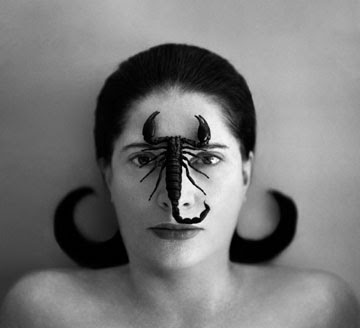
Marina Abramovic


«(…) Esta artista serbia nacida en Belgrado (Yugoslavia) es una de las pioneras en la realización de performance, comenzando en la década de los 70, lo que hace que se autodefina como «la abuela de la performance». Transgresora, rupturista, radical, son algunos de los adjetivos que conforman la obra y el papel de esta artista que desde sus inicios denuncia la opresión y el retraso de su realización como ser por culpa del sistema educativo establecido en su país, utilizando su  propio cuerpo como elemento fundamental de la experiencia en la que basa su estudio comunicativo entre su ser y en entorno que le rodea, incluyendo al público en su propia performance y haciéndolo partícife fundamental. Sin embargo los temas de sus obras recorren también la exploración de la espiritualidad en el sexo, ampliando su experiencia artística más allá de los soportes convencionales, siendo el mayor protagonista el cuerpo del sujeto, que guarda en sí toda la experiencia vital en la que Abramovic centra su interés como tema, siendo la relación vida-muerte una constante en su obra.

Pero será la más célebre de sus performance:  «Ritmo 0» en el año 1974  cuando llegue al extremo de su entrega personal a la causa de su obra. En esta ocasión la artista asumía la sumisión ante la voluntad del público, invitando a éste a intervenir en su cuerpo con cualquiera de los 74 objetos elegidos por la artista, entre los que se encontraban tanto objetos cuyo fin es una experiencia placentera  como objetos de agresión: cuchillos, látigo, tijeras e incluso una pistola y una bala. Durante seis horas estuvo su cuerpo expuesto a merced de la voluntad de los espectadores, que en un principio se mostraba tímido y respetuoso en sus intervenciones, sin embargo, a medida que pasaban las horas la agresividad iba en aumento hasta el punto de que alguien llegó a colocar la bala en la pistola y apuntó a Abramovic, que permanecía impasible; ella misma admitió que era «la única performance en la que estaba dispuesta a morir».

Es realmente interesante no sólo el proceso artístico, que lleva implícito una labor intelectual compleja, sino los resultados que concluyen la obra, como la demostración de la agresividad sin razón, dando así lugar incluso a la reflexión sobre la psicología y conducta humana.
Varias de sus obras las realiza en conjunto con el artista Uwe Laysiepen. «Death self» o «La muerte misma» es una de las performance más interesantes, y en la línea de autodestrucción como medio de transmisión de su mensaje de un modo directo, impactante y rotundo pensando para despertar consciencias. Abramovic y Laysiepen (o Ulay, su nombre artístico) unian sus labios y el aire que inspiraban era el que expiraba el otro, de modo que al cabo de diecisiete minutos no quedaba oxígeno en sus pulmones, por lo que cayeron simultáneamente inconscientes. De nuevo una lección: la capacidad del individuo de interferir en la vida de la otra persona afectándola negativamente, anulándola, controlándola e incluso destruyéndola. «
«En los años 70, Marina Abramovic mantuvo una intensa historia de amor con Ulay. Pasaron 5 años viviendo en una furgoneta realizando toda clase de performances. Cuando su relación ya no daba para más, decidieron recorrer la Gran Muralla China, empezando cada uno de un lado, para encontrarse en el medio, abrazarse y no volver a verse nunca más. 23 años después, en 2010, cuando Marina ya era una artista consagrada, el MoMa de Nueva York dedicó una retrospectiva a su obra. Dentro de la misma, Marina compartía un minuto en silencio con cada extraño que se sentaba frente a ella. Ulay llegó sin que ella lo supiera, y esto fue lo que pasó…»
Publicado en Sin categoría | 2 Comentarios

p o e t r y

cuando el sol quema entre las piernas

en los lóbulos

y en los tobillos


cuando las hojas resecas se deshacen

y el olor a césped joven se filtra en tus costillas


cuando el ceño fruncido por la luz

observa un infinito amorfo

azul

y descalzo


cuando las ramas en silencio hacen el amor

y nacen al fin las flores nácar

del naranjo

del almendro

del cerezo,

de tus labios


cuando los pájaros festejan

y sus alas son de viento


cuando el viento es de plumas

y estornuda mi nariz


cuando duermen los bostezos

en las tardes de marzo


Pienso…

Pienso que en tu boca es primavera


Andrea

Publicado en Sin categoría | Deja un comentario